Reading a Leopard: The Body Cues That Tell You a Stalk Is About to Begin

Leopard behaviour | Wildlife photography tips | Big cat body language | Kenya wildlife photography
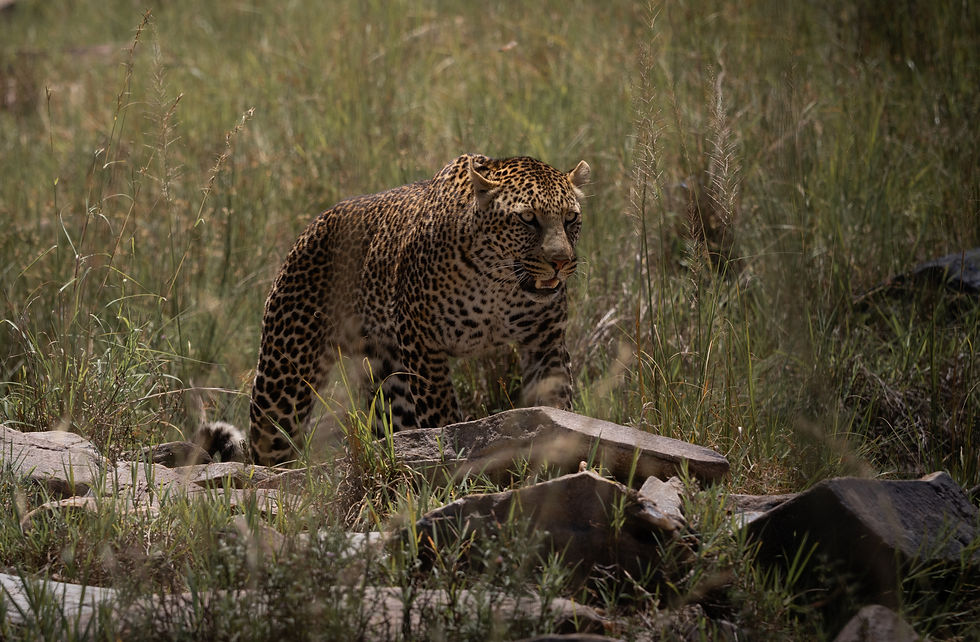
Of all the large predators in East Africa, the leopard is the one that will teach you most ruthlessly whether you are actually watching.
Lions give you time. A pride moves slowly, rests conspicuously, and telegraphs its intentions across dozens of metres of open savanna. Even cheetahs, for all their explosive speed, follow a relatively readable arc from rest to scan to stalk to sprint that unfolds over minutes.
A leopard that has decided to hunt is a different education entirely. The behavioural shift from rest to committed stalk can happen in under ten seconds. The stalk itself is low, slow, and silent, a sequence of movements so controlled and deliberate that it can be almost hypnotic to watch, until it suddenly isn't, and you are fumbling with your focus because you were not ready for how fast the end of it came.
This post is about how to read a leopard well enough to be ready.
Understanding the Leopard's Approach to the World
Before the specific signals, some context about leopard ecology that informs how they behave and how you should watch them.
Leopards are solitary, territorial, and fundamentally secretive. Unlike lions, which live in social groups and can afford a degree of visibility, leopards have evolved to operate in cover. Their rosette patterning is among the most effective camouflage in the animal kingdom in dappled light and woodland. Their default response to most situations is concealment, not display.
This means that the first challenge with leopards is simply finding them. A leopard at rest in a fig tree or a palm grove is remarkably difficult to see even when you know approximately where to look. Learning to spot the horizontal line of a body against vertical branches, the weight of a tail hanging below a fork, the glint of an amber eye in deep shade, this is the first skill, and it is worth developing independently of the subsequent behaviour reading.
The second context point is that leopards are largely crepuscular, most active at dawn and dusk. The hunting behaviour you are most likely to observe happens in these windows. A leopard that has been resting through the middle of the day will begin to change behaviourally as the afternoon light drops, and knowing what that change looks like gives you lead time to prepare.

The Pre-Hunt Behavioural Sequence
There is no single signal that definitively announces a leopard is about to hunt. There is a sequence, a shift in the whole quality of the animal's attention and body, that accumulates into certainty if you know what you are accumulating.
The first change: the quality of alertness.
A resting leopard has a particular look - body relaxed, muscles loose, often eyes partially or fully closed, tail hanging or moving with the slow, irregular rhythm of drowsiness. When something changes in the environment that the leopard registers as potential prey, the first shift is subtle: a very slight increase in muscular tone. The body does not move, but it is no longer completely at ease. The tail stills. The eyes, if they were partially closed, open fully. The ears rotate independently, triangulating.
This is the moment to raise your camera. Not because anything is definitely about to happen, the leopard may assess and return to rest, but because this is the point at which you want to be ready. Everything that follows will happen faster than you expect.
The second change: fixed gaze.
The leopard's eyes lock onto a specific point. Unlike the scanning attention of an alert animal, a hunting-focused gaze is absolutely still - unwavering, directed, intense. The head moves only to compensate for prey movement, tracking with the precision of a gunsight. If you can see what the leopard is looking at, you can follow the sightline and often find the prey animal.
At this stage, the ears are typically both rotated fully forward, cupped toward the target. The nostrils may flare slightly as the leopard refines its scent picture of the target and the wind.
The third change: the body lowers.
The crouch preceding a leopard stalk is not a sudden drop. It is a gradual, controlled compression, as if the leopard is slowly releasing air. The shoulder blades rise as the body descends. The belly may not quite touch the ground in early stages, but the profile decreases dramatically. The tail is typically extended straight behind, held level or slightly elevated at the tip, and may begin a slow, controlled undulation.
This is the committed signal. Once the body drops into the low crouch, the leopard has decided. It is now a question of execution.
The fourth change: the stalk begins.
Leopard movement during a stalk is one of the most extraordinary things in nature to observe. Each foot placement is deliberate and silent. The body stays compressed and level, moving forward with a flowing, almost liquid quality that eliminates any vertical bobbing that might catch the prey's eye. Experienced trackers describe it as the leopard seeming to pour itself across the ground.
Pace during the stalk varies with distance and cover. At long range with good cover, a leopard may stalk at almost imperceptible speed, covering ground over many minutes in increments that are visible only when you compare position to a fixed reference point. At medium range, the movement becomes more purposeful. At close range, if the prey has not detected the approach, the stalk transitions into a very fast, low sprint covering the final metres.
The final phase: the rush and the strike.
The terminal rush is explosive and brief, typically covering between five and fifteen metres in under two seconds. If the stalk has been successful, the prey does not detect the leopard until it is already in the air. The strike targets the throat of small to medium prey and the nape of large prey.
The entire sequence from the first body lowering to the strike can take anywhere from thirty seconds to forty minutes depending on distance, cover, and prey behaviour. Most photographers who miss it have stopped watching during the middle stages, assuming it will take longer.

Specific Signals to Watch for in Different Contexts
Leopard in a tree with prey. A leopard that has a kill hoisted in a tree and descends from the tree is not necessarily hunting, it may be repositioning the kill, drinking, or simply resting at a lower level. Watch for the full hunting sequence before assuming a descent means another hunt is beginning. However, if a second prey animal moves beneath the tree, and the leopard's body language shifts to the fixed gaze and lowering posture described above, you are watching something rare and remarkable: an opportunistic drop-hunt from a tree, which does occasionally occur.
Leopard on the ground at dusk. This is the most common hunting context. The leopard typically begins moving purposefully as the light drops, covering ground along established paths and drainages where prey animals concentrate near water. Watch the ears and the quality of movement, a leopard moving with destination intent walks differently from a leopard that has registered potential prey and begun to hunt. The hunting leopard moves slower, lower, and with greater deliberateness.
Leopard with cubs. A mother with cubs is simultaneously more focused on hunting, she needs more food to support lactation and cub provisioning, and more likely to abandon a hunt if disturbed. Cub behaviour can itself signal that a hunt is beginning: young cubs, who accompany their mother on hunts from a few months old, will often settle and become very still when the mother's behaviour shifts into hunting mode. They have learned the signal. You can learn it from them.

Photographic Preparation for the Hunting Sequence
Knowing what to watch for is one thing. Being technically ready when it unfolds is another.
Continuous AF from the first signal. The moment a leopard's body language shifts into the pre-hunt mode, lock your continuous autofocus onto the eyes and keep it there. Modern mirrorless cameras with subject tracking are well-suited to this, they maintain lock through the stalk even if the leopard moves into partial cover. Do not wait until the terminal rush to engage your AF; by then, everything is moving too fast for initial acquisition.
High shutter speed throughout. I shoot a minimum of 1/1600s once a leopard shows hunting intent, regardless of what the light is doing. The terminal rush lasts under two seconds and covers significant distance, even at 1/1600s, a leaping leopard can show some blur in the extremities. At 1/2500s or faster, you have a better chance of truly sharp frames through the strike. Accept higher ISO in exchange for shutter speed.
Burst mode, but think in sequences. High-speed burst during the rush produces a lot of frames, many of which will be very similar. The more interesting photographs often come from the stalk itself - the lowering body, the fixed gaze, the controlled movement through cover. These require considered single frames or short bursts at specific moments, not indiscriminate high-speed firing. Practise using burst selectively rather than running it continuously from first signal to conclusion.
Exposure for the transition from cover to open. If a leopard is stalking through alternating cover and open ground, your exposure may need to adjust as it moves. A leopard emerging from deep shade into open sunlight requires a rapid exposure compensation shift, potentially two stops or more. In manual mode, have your thumb ready on the ISO dial or exposure compensation. This is one of the technically hardest aspects of shooting leopard hunts in dappled environments.
Compose with the destination in mind. If you can identify the prey animal and the likely direction of the terminal rush, position your composition to include space ahead of the leopard in the direction of movement. A hunting leopard in the centre of the frame with nothing ahead of it is compositionally static. A leopard at the edge of the frame with the prey visible at the far edge, or the empty space where the prey will be, is a photograph full of imminent narrative.
Patience as a Skill
There is a quality of attention required to watch a leopard hunt that is genuinely demanding. The stalk can be very slow. Other things will happen around you, other vehicles, radio communications, movement in a different direction. The temptation to look away is constant.
The photographers who consistently capture leopard hunting sequences have a specific quality of focused patience that is, I think, a learned skill as much as an innate one. They stay with the animal through the slow middle stages. They keep their eye to the viewfinder even during apparent pauses. They have learned, from experience, that the moment they look away is often the moment the terminal rush begins.
The deepest reward of leopard photography is not the strike itself, though that is extraordinary. It is the accumulated understanding of an animal that operates on its own terms, at its own pace, in ways that become legible only through sustained, respectful, attentive watching. You do not decode a leopard from a distance. You earn the understanding through presence, over time.

Further Resources
For the full behavioural vocabulary of leopards and East Africa's other major predators, including specific photographic guidance for each species and stage of behaviour, my Animal Behaviour Field Notes guide is the most comprehensive resource I have produced. The Wildlife Behaviour and Photography Cards include leopard-specific reference cards covering the complete hunting sequence, social and territorial behaviours, and mother-cub dynamics, designed to be carried on a game drive and consulted in the field.


Comments